

# Navigating Market Volatility in 2026: SIP vs Lumpsum Mutual Fund Calculators
Equity market movements in 2026 reflect a dynamic mix of macroeconomic policy shifts, technological innovation in AI/SaaS, and changing global trade patterns.
For retail investors and wealth managers, determining whether to deploy capital via a **Systematic Investment Plan (SIP)** or a **Lump Sum Investment** is a fundamental allocation decision.
---
1. Defining SIP vs. Lump Sum Strategies
Systematic Investment Plan (SIP)
A SIP involves investing a fixed dollar amount at regular intervals (monthly or quarterly) into equity mutual funds or index ETFs.
- **Core Benefit**: Rupee/Dollar Cost Averaging—automatically purchasing more units when prices fall and fewer units when prices rise.
- **Psychological Advantage**: Eliminates emotional market timing mistakes during volatile market corrections.
Lump Sum Investment
Lump sum investing involves deploying a significant pool of capital into an asset class all at once.
- **Core Benefit**: Maximum time in the market—capital starts compounding immediately across the full principal.
- **Risk Factor**: Vulnerable to short-term market corrections if deployed at market peaks.
---
2. Comparing Compounding Returns Across Market Cycles
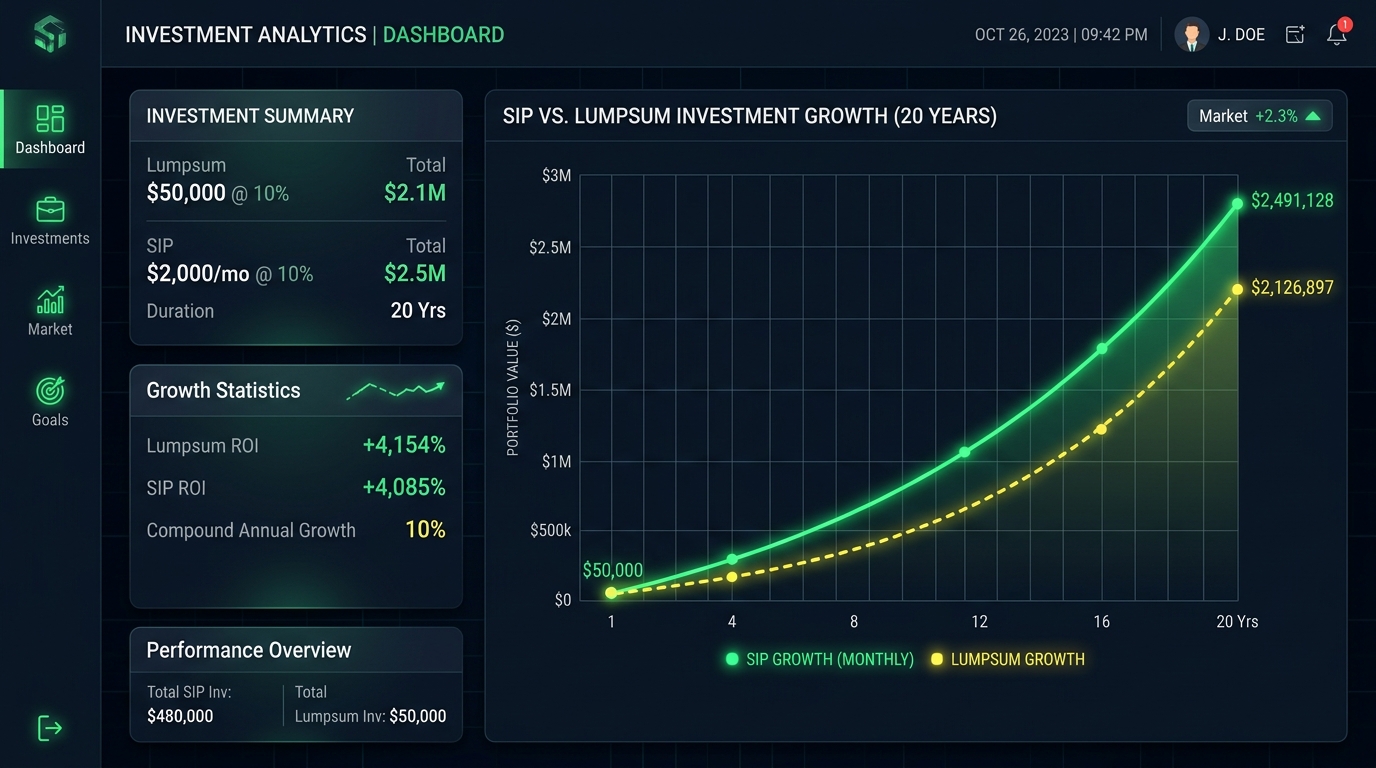
Over long horizons (10–20+ years), mathematical modeling demonstrates that lump sum investments slightly outperform SIPs in steadily rising bull markets because 100% of capital compounds from Day 1.
However, in realistic market environments characterized by cyclical swings and corrections, SIP strategies deliver superior risk-adjusted stability for ongoing income earners.
The Power of Compound Interest
$$\text{Future Value} = P \times (1 + r)^n + \text{SIP Contributions Compounded}$$
Using interactive SIP and Lumpsum calculators allows investors to visualize how compound interest accelerates wealth creation exponentially after the initial 7–10 year mark.
---
3. How to Use Investment Calculators for Portfolio Growth
Interactive financial calculators help investors solve key wealth planning questions:
- **Goal-Based Target Calculation**: Determine exact monthly SIP contributions required to reach specific wealth targets (e.g., $500,000 retirement corpus).
- **Step-Up SIP Modeling**: Calculate how increasing monthly SIPs by 5-10% annually dramatically shortens the timeline to financial independence.
- **Inflation-Adjusted Target Portfolio**: Project future portfolio value in real purchasing power terms.
By combining disciplined monthly execution with interactive calculator projections, investors can navigate 2026 market volatility with confidence.