

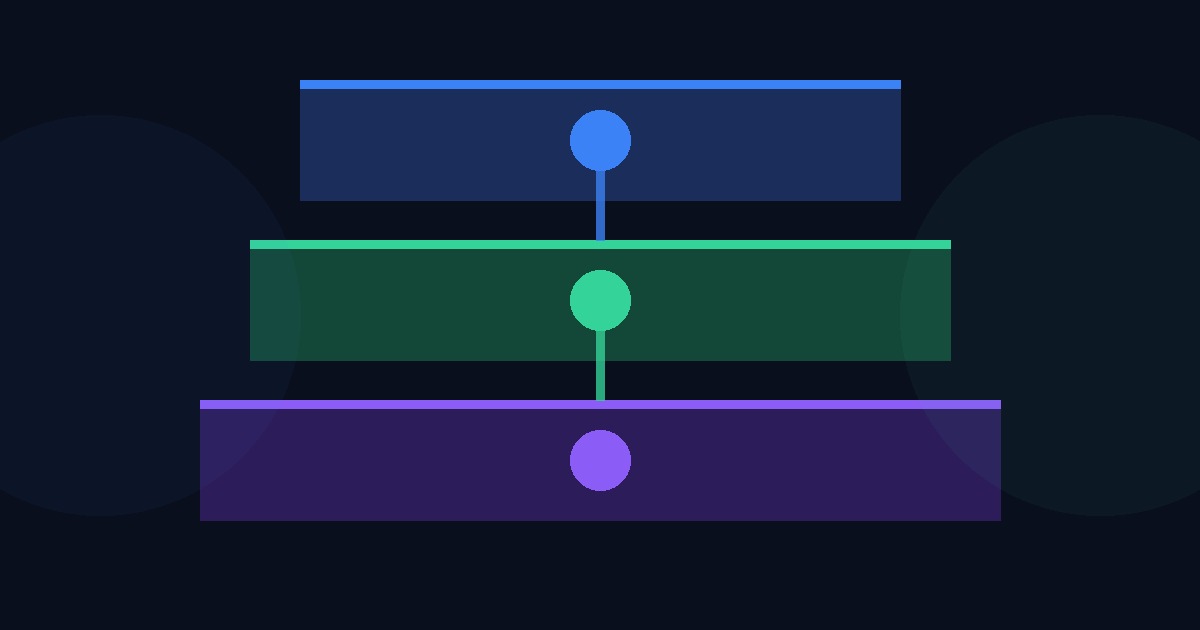
Every digital product you use is a conversation between two worlds: the interface you see and tap, and the hidden machinery storing data, processing payments and enforcing rules. A full stack developer is fluent in both. They can design a database schema in the morning, build the API serving it by noon and polish the interface consuming it by evening, which makes them among the most versatile, employable professionals in technology.
The title carries almost mythical weight in India's job market, attached equally to genuine opportunity and inflated expectations. This guide separates the two: what full stack developers actually do, which technologies matter in 2026, what salaries look like realistically at each level, how to become one without wasting years wandering tutorials and which myths about the role deserve retiring.
What Is a Full Stack Developer?
A full stack developer builds complete web applications across every architectural layer: frontend (what users see), backend (the server logic processing requests) and the database plus infrastructure connecting them. Where specialists handle one layer deeply, full stack developers move across all of them, owning features end-to-end from first commit to production deployment.
The definition matters because misconceptions cluster around it. Full stack does not mean expert in everything; it means competent enough across layers to ship working software independently while knowing when to consult specialists. Think of it like a general practitioner in medicine: broad capability, sound judgement about limits, deep relationships with specialists for complicated cases.
Companies prize this profile for a specific economic reason: coordination cost. Every feature crossing team boundaries requires meetings, handoffs and integration negotiation. One capable full stack developer replacing a two-person relay removes entire categories of delay, which is why startups, agencies and small product teams hire them persistently even when large enterprises prefer deeper specialists.
The honest trade-off deserves equal billing. Spreading across layers means fewer hours available for any single one, so full stack developers typically match specialists' breadth rather than their peak depth. Successful ones manage this deliberately: strong general competence everywhere, chosen depth somewhere, and humility about the remainder.
It also helps to understand what the role is not. Full stack does not mean doing everything alone forever: mobile development, complex infrastructure, machine learning and heavy data engineering all sit outside the typical scope. Nor does it mean skipping design; full stack developers implement designs faithfully but rarely originate brand systems. The clearest framing: a full stack developer owns the web product end-to-end while relying on specialists, tools or teammates for domains beyond it.
What a Full Stack Developer Actually Does All Day
Daily work varies more than most roles because projects pull from every layer. A representative day might open with backend work: writing an API endpoint that returns a customer's order history, including pagination and sensible error responses when records are missing.
Mid-morning shifts frontend: building the interface page that consumes yesterday's endpoint, wiring loading states, empty states and error handling so users never face unexplained blanks. Integration follows naturally, connecting both halves, then testing the complete flow manually before pushing code through automated checks.
Afternoons often bring infrastructure tasks: reviewing why staging deployed slowly, rotating expiring credentials, checking error-monitoring dashboards where one recurring exception deserves investigation. Code review fills gaps; as a full stack developer you review meaningfully across the entire stack, catching both an unsafe database query and an inaccessible button in the same afternoon.
Client communication threads through everything. Because full stack developers understand whole systems, stakeholders route questions directly to them: how long for this feature, why did that integration fail, what would scaling cost. Translating technical reality into business language is not overhead in this role; it is half the value.
Frontend vs Backend vs Full Stack: Which Path Fits You?
Choosing between specialisation paths shapes years, so match choice to temperament honestly.
Frontend suits builders energised by visible results: layouts responding to your changes instantly, animations polishing interaction, design sensibility mattering daily. Feedback arrives fast and visually.
Backend suits systematic thinkers who prefer logic puzzles over pixels: modelling data cleanly, optimising queries, designing APIs others enjoy consuming. Quality manifests as reliability rather than appearance.
Full stack suits autonomy-seekers who want ownership of whole outcomes and tolerate context-switching happily. The breadth tax is real; curiosity across layers must be genuine, because faking interest in either half makes the role exhausting within months.
Practical advice for undecided beginners: start with frontend fundamentals since everyone needs them regardless, then learn backend basics next. By touching both, you discover your preference with evidence instead of speculation, and either specialist path remains fully open afterward.
One further consideration: market reality in India. Job postings titled full stack developer frequently describe either frontend-heavy or backend-heavy roles with some coverage of the other side. Read responsibilities carefully during applications rather than trusting titles; matching your genuine strengths to what each employer actually needs prevents mismatched offers and early exits alike.
The Modern Full Stack Tech Stack in 2026
Technology rotates; categories endure. Here is what serious 2026 stacks look like:
Frontend Layer
HTML, CSS and JavaScript remain foundational, with TypeScript now standard in professional codebases. React dominates component frameworks, usually paired with Next.js when applications need server-side rendering, routing conventions or hybrid rendering. Tailwind CSS has become the mainstream styling approach alongside design-system components.
Backend Layer
Node.js with Express or NestJS lets JavaScript span the stack, remaining the most common learning path. Python serves teams favouring readability and data work; PHP with Laravel persists strongly across Indian agency work; Java anchors enterprise backends. REST APIs remain universal, GraphQL where clients demand flexible queries.
Databases
PostgreSQL has become the default relational choice: robust, feature-rich and free. MySQL remains widespread in legacy and hosting environments. MongoDB suits document-shaped data and rapid prototyping. Knowing SQL properly matters regardless of engine, because relational thinking underpins nearly everything.
DevOps and Deployment
Git platforms anchor collaboration. CI/CD pipelines through GitHub Actions automate testing and deployment. Hosting spans Vercel and Netlify for frontends, cloud providers like AWS for infrastructure, with Docker containerising environments increasingly routinely. Error monitoring and uptime alerting close the operational loop professionals refuse to skip.
Beginners should read this list as a menu, not a checklist. One coherent path, say React plus Node plus PostgreSQL, learned deeply beats three alternatives sampled shallowly, and switching costs shrink dramatically once fundamentals hold.
A note on choosing among stacks: optimise for learning quality rather than trend-chasing. JavaScript-everywhere paths let beginners reuse one language while spanning layers, halving early cognitive load. Python-first paths suit those drawn toward data work later. Laravel paths align with enormous Indian agency demand for PHP maintenance and customisation. All three produce employable developers; employers screen for depth within your chosen stack far more than which stack you chose.
Whatever you pick, commit for at least twelve months before evaluating alternatives. Stack-hopping is the most expensive habit in this field: every switch restarts framework fluency to zero while fundamentals quietly wait for the attention they actually needed.
Skills Beyond Code That Define Senior Full Stacks
Code alone caps careers early. The capabilities that compound:
- System design thinking: decomposing requirements into services, schemas and interfaces before typing.
- Security fundamentals: input validation, authentication done properly, secrets managed safely, common vulnerabilities recognised on sight.
- Debugging methodology spanning layers: reproducing issues reliably, isolating whether faults live in browser, network or server.
- Estimation and communication: translating ambiguity into plans, warning early, documenting decisions for successors.
- Product sense: understanding why features exist, which details deserve perfection and which deserve shortcuts.
Interview processes increasingly probe these directly through system-design discussions and behavioural questions, precisely because they predict senior performance better than any syntax quiz.
Full Stack Developer Salary in India
Compensation varies with city, company stage and demonstrated depth. These bands reflect typical market patterns rather than guarantees: individual offers swing meaningfully on portfolio strength, interview performance and negotiation. Product companies and funded startups generally pay above local agencies for equivalent experience, and remote international roles play in an entirely different league, often two to four times Indian market rates.
Entry-Level Salary (0–2 Years)
Freshers typically earn ₹3.5 lakh to ₹7 lakh annually. Candidates presenting deployed full-stack projects, working authentication included, consistently enter above certificate-only peers regardless of college background.
Mid-Level Salary (2–5 Years)
Developers independently shipping features across layers commonly earn ₹8 lakh to ₹18 lakh. Depth in one high-demand pairing, React with Node, or Python with modern cloud deployment, pushes offers toward the upper range.
Senior Salary (5+ Years)
Seniors owning architecture and mentoring across the stack typically reach ₹18 lakh to ₹40 lakh in product companies, extending substantially higher in funded startups and international remote roles. Freelance full stack developers serving foreign clients operate in a different market altogether, bounded only by positioning and pipeline.
Across levels, pay tracks ownership scope. Developers trusted to make decisions command multiples of equally experienced executors waiting for instructions, making deliberate movement toward ownership the highest-leverage career strategy available.
City matters too: Bengaluru, Hyderabad, Pune, Mumbai and Delhi NCR host the densest concentration of full stack openings and the strongest bands, though remote-first hiring has steadily flattened these gaps. When comparing offers, weigh total compensation, learning exposure and ownership scope together; the highest base salary is frequently not the highest-value role three years later.
How to Become a Full Stack Developer: Step-by-Step Roadmap
No degree gate protects this career; demonstrable ability decides hiring entirely. The following sequence assumes consistent weekly effort and adjusts naturally to your pace:
- Master HTML, CSS and JavaScript fundamentals first. Four to six weeks recreating real layouts and building small interactive widgets. Resist framework temptation until vanilla comfort is genuine, because premature abstraction produces developers who freeze outside tutorials.
- Learn Git immediately and forever. Commit daily, publish publicly, write meaningful messages. Your contribution history becomes silent testimony long before interviews arrive.
- Go deep on one frontend framework. React offers India's largest market. Build five progressively complex applications, culminating in something consuming real APIs with authentication, routing and state handled properly.
- Learn one backend language and framework thoroughly. Node with Express mirrors your JavaScript investment efficiently. Study routing, middleware, validation, error handling and authentication by building the APIs your frontend apps consume, then rebuilding them better.
- Learn SQL and one database deeply. PostgreSQL recommended. Practise schema design, joins, indexing basics and migrations until modelling data feels routine rather than frightening. Understand why schemas designed carelessly haunt applications for years.
- Connect the halves completely. Build two full applications end-to-end: user registration through session handling, forms through validated storage, dashboards through aggregated queries. Deployment counts; unfinished local projects convince nobody.
- Add professional practices. Automated tests on critical flows, environment configuration discipline, basic CI pipeline, error monitoring. These separate employable engineers from tutorial graduates faster than any additional language.
- Prepare deliberately for interviews. Practise explaining architecture decisions aloud, solve moderate problems daily, prepare honest stories about bugs conquered, then apply broadly and iterate on feedback visibly.
Throughout every stage, maintain a public learning log: short weekly notes on what you built and what broke. Twelve months of such notes documents persistence better than any certificate and gives interviewers abundant evidence of genuine engagement with the craft.
Dedicated part-time learners typically reach employability within ten to sixteen months; intensive learners compress toward eight. Consistency outperforms bursts sustained briefly, always.
Projects That Prove You Are Job-Ready
Portfolios decide hiring outcomes here more than resumes. Three project archetypes cover evaluation criteria comprehensively:
- A complete SaaS-style application: user accounts, role-based access, CRUD operations, payments sandbox integration, polished responsive UI and deployment. This single project demonstrates nearly every skill employers screen for.
- A real-world service project: something built for an actual person or small business, however modest. Real constraints and feedback teach lessons simulated briefs cannot, and the story differentiates interviews memorably.
- An open-source contribution or public tool: even documentation improvements or a small utility package demonstrate community engagement and code surviving strangers' scrutiny.
Document each project with a brief readme covering problem, architecture decisions, trade-offs accepted and future improvements imagined. Screenshots attract clicks; documented reasoning earns interviews.
Quality bar matters more than quantity: three polished, deployed, explainable projects outperform ten half-finished experiments. Before adding any project to your portfolio, test it on a phone, on a slow connection and with a keyboard alone, then fix what frustrates you. Interviewers click the way users do.
How Companies Actually Evaluate Full Stack Candidates
Understanding evaluation from the other side of the table sharpens preparation enormously. Screening typically proceeds through four filters.
Portfolio review comes first and decides most outcomes silently: recruiters click deployed links, test them on phones and abandon broken or slow ones without notification. Surviving portfolios show complete applications rather than tutorial clones.
Technical interviews then probe depth within your claimed stack: moderate coding problems, framework-specific questions about state and rendering behaviour, database queries written live. Full stack candidates additionally face cross-layer scenarios, where should this validation live, how would you debug a slow page end-to-end, because boundary judgement defines the role.
System design discussions arrive at mid-level and above: designing a URL shortener or booking system on a whiteboard, evaluating your instincts about schemas, caching and failure modes. Preparation here is practice articulating trade-offs aloud, not memorising architectures.
Finally, behavioural rounds examine ownership history: stories of bugs you chased to root cause, deadlines you renegotiated honestly, decisions you reversed when evidence changed. Candidates who prepared three such specific stories consistently outperform those who improvised generically.
Freelancing vs Full-Time Jobs for Full Stack Developers
Full-time employment remains the strongest launchpad for most entrants. Teams expose you to codebases far larger than personal projects, reviews compress years of habit-formation into months, and specialisation happens naturally around real product needs. Steady income also lets early-career developers decline bad clients instead of absorbing them.
Freelancing and studio building suit developers who want autonomy and direct market feedback. Full stack breadth is precisely what makes independent work viable: you can deliver complete products without assembling a team for every project. Indian freelancers serving international clients routinely earn multiples of local salaried rates, though income arrives unevenly and business development never pauses.
Agency entrepreneurship extends the same logic further: hiring specialists around your full stack core lets you serve larger clients while staying hands-on technically. Many respected Indian studios began exactly this way, with a capable generalist delivering early projects personally and delegating selectively as demand grew.
Whichever model attracts you, sequence matters more than preference: competence precedes confidence, confidence precedes clients, and skipping steps bills someone eventually. Build employed experience first unless circumstances genuinely force otherwise, then transition when pipeline evidence rather than frustration justifies the leap.
Common Myths About Full Stack Development
Retiring these myths prevents wasted years:
- Myth: full stack means mastering everything. Reality: it means broad competence with chosen depth and honest awareness of limits; chasing total mastery produces perpetual beginners.
- Myth: full stack developers earn more automatically. Reality: compensation tracks ownership and impact, not title breadth; specialists in demand frequently outearn shallow generalists.
- Myth: you must learn multiple languages simultaneously. Reality: one coherent stack learned deeply beats three sampled superficially; adding languages later takes weeks once fundamentals solidify.
- Myth: AI tools are eliminating the role. Reality: AI accelerates boilerplate dramatically but still requires humans who specify correctly, integrate safely, debug systematically and own outcomes. The role shifts upward in abstraction rather than disappearing.
- Myth: bootcamp certificates substitute for proof. Reality: certificates open no doors that deployed repositories have not already opened wider.
Frequently Asked Questions
Frequently Asked Questions
- What exactly does full stack mean?
- It describes developers competent across every application layer: frontend interface, backend logic and database plus deployment concerns. The term describes breadth of capability rather than any specific technology combination.
Frequently Asked Questions
- Can beginners start directly with full stack?
- Technically yes, practically unwise. Fundamentals come first regardless: HTML, CSS, JavaScript, then one layer deepened before spanning both. Beginners attempting everything simultaneously usually master nothing while burning motivation reserves.
Frequently Asked Questions
- Which is better, specialising or becoming full stack?
- Neither universally. Specialists deepen faster and suit large-product environments; full stacks ship autonomously and suit startups, agencies and entrepreneurial paths. Choose by temperament and target employers rather than salary folklore.
Frequently Asked Questions
- How long does becoming job-ready take?
- Ten to sixteen months at consistent part-time effort is typical, compressing toward eight months intensive. Readiness arrives when deployed end-to-end projects exist and their architecture can be explained confidently, never when course completion certificates arrive.
Frequently Asked Questions
- Do full stack developers need computer science degrees?
- No. Indian hiring evaluates portfolios, practical tests and references overwhelmingly over credentials. Self-taught full stack developers staff companies nationwide, and public code speaks louder than any degree line.
Frequently Asked Questions
- What stack should I learn in 2026?
- One coherent path suffices: JavaScript throughout via React, Next.js, Node.js and PostgreSQL remains the highest-opportunity combination for Indian learners. Alternatives serve fine once fundamentals transfer; depth matters far more than brand selection.
Frequently Asked Questions
- How do full stack developers keep up with changing technology?
- They anchor on durable fundamentals, HTTP, databases, rendering, security, then evaluate new tools against problems actually faced rather than hype cycles. Communities, release notes and side projects absorb change gradually; panic-chasing every trend exhausts without enriching.
Frequently Asked Questions
- Should I work full-time first or start freelancing immediately?
- Employment first serves most people better. Teams impose standards, reviews accelerate growth and steady income removes desperation from early decisions. Two or three years inside good teams builds the speed and confidence that make freelancing viable; freelancers who skip this stage typically underprice themselves into burnout.
Final Thoughts
Full stack development rewards curious generalists who finish things: people comfortable spanning interface aesthetics and server logic, patient enough to build fundamentals properly and pragmatic enough to ship imperfect versions early. Learn one coherent stack deeply, build complete applications repeatedly, deploy everything publicly and document decisions generously along the way.
And if you run a business rather than a career search, this profile explains our studio's structure. UI Designer pairs design craft with full-stack engineering so projects ship end-to-end under one accountable team: strategy, interface, code and launch handled together. Visit ui-designer.in to explore recent work and book a free consultation about yours.