

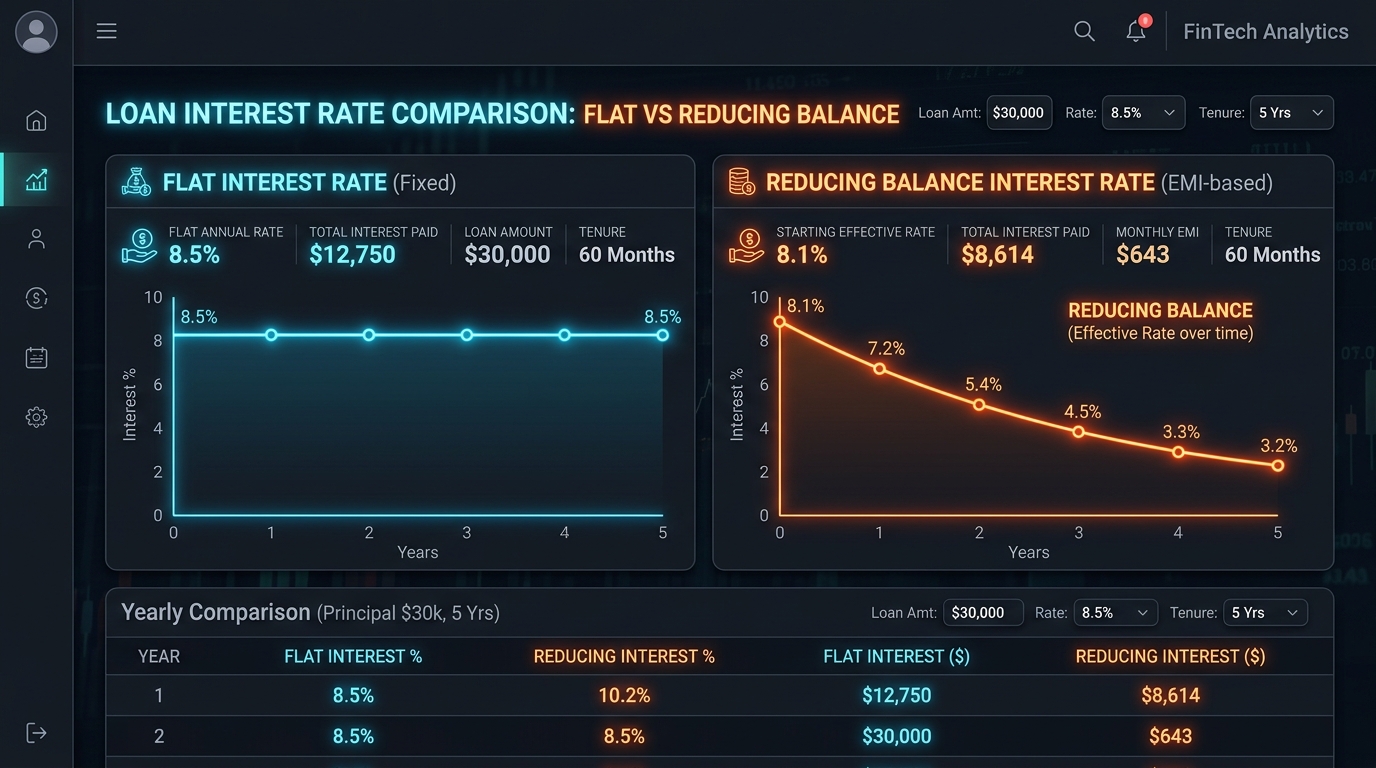
# Flat Rate vs. Reducing Balance Interest Rate: The Hidden Cost in 2026 Loan Products
When evaluating personal loans, auto loans, or commercial financing in 2026, borrowers are frequently presented with two distinct methods of interest calculation: **Flat Interest Rate** and **Reducing Balance (Diminishing) Interest Rate**.
Understanding the mathematical difference between these two structures can save borrowers thousands of dollars over the lifetime of a credit product.
---
1. What is a Flat Interest Rate?
Under a flat rate loan, interest is calculated on the **full initial principal amount** throughout the entire loan tenure, regardless of how much principal has already been repaid through monthly Equated Monthly Installments (EMIs).
Flat Rate Formula
$$\text{Total Interest} = P \times R \times T$$
Where:
- $P$ = Initial Principal Loan Amount
- $R$ = Annual Flat Interest Rate
- $T$ = Tenure in Years
Because the principal baseline never decreases in the calculation, the effective annual interest rate (APR) is significantly higher than the advertised flat rate percentage.
---
2. What is a Reducing Balance Interest Rate?
In a reducing balance interest model, interest is calculated on the **outstanding principal balance** remaining at the end of each payment period (monthly). As each EMI reduces the outstanding debt, the interest component of subsequent installments decreases progressively.
Monthly Reducing Interest Calculation
$$\text{Interest for Month } n = \text{Outstanding Principal}_n \times \frac{\text{Annual Rate}}{12}$$
This is the standard calculation methodology mandated by major central banks and ethical banking institutions worldwide.
---
3. Flat Rate vs. Reducing Rate Comparison
To see the real-world impact, consider a loan of **$10,000** over **5 years (60 months)** at an advertised rate of **8%**:
| Loan Parameter | Flat Interest Rate (8%) | Reducing Balance Rate (8%) | | :--- | :--- | :--- | | **Initial Loan Amount** | $10,000 | $10,000 | | **Total Interest Paid** | $4,000 | $2,166 | | **Total Amount Repaid** | $14,000 | $12,166 | | **Monthly EMI** | $233.33 | $202.76 | | **Effective APR** | **~14.5%** | **8.0%** |
Notice that an 8% flat rate loan actually costs nearly **double** the interest of an 8% reducing balance loan!
---
4. Why Use a Flat vs Reducing Rate Calculator?
Financial comparison calculators instantly translate advertised flat rates into their true effective reducing rate equivalents. By plugging loan terms into an interactive calculator, borrowers can:
- **Uncover Hidden Borrowing Costs**: Identify marketed "low" flat rates that carry high true APRs.
- **Compare Multi-Bank Offers**: Standardize competing loan offers on an apples-to-apples reducing rate basis.
- **Plan Early Pre-payments**: Understand how principal pre-payments reduce future interest burdens under reducing balance schedules.
Before signing any credit agreement in 2026, always run the figures through a trusted financial calculator to ensure full transparency over your repayment terms.