

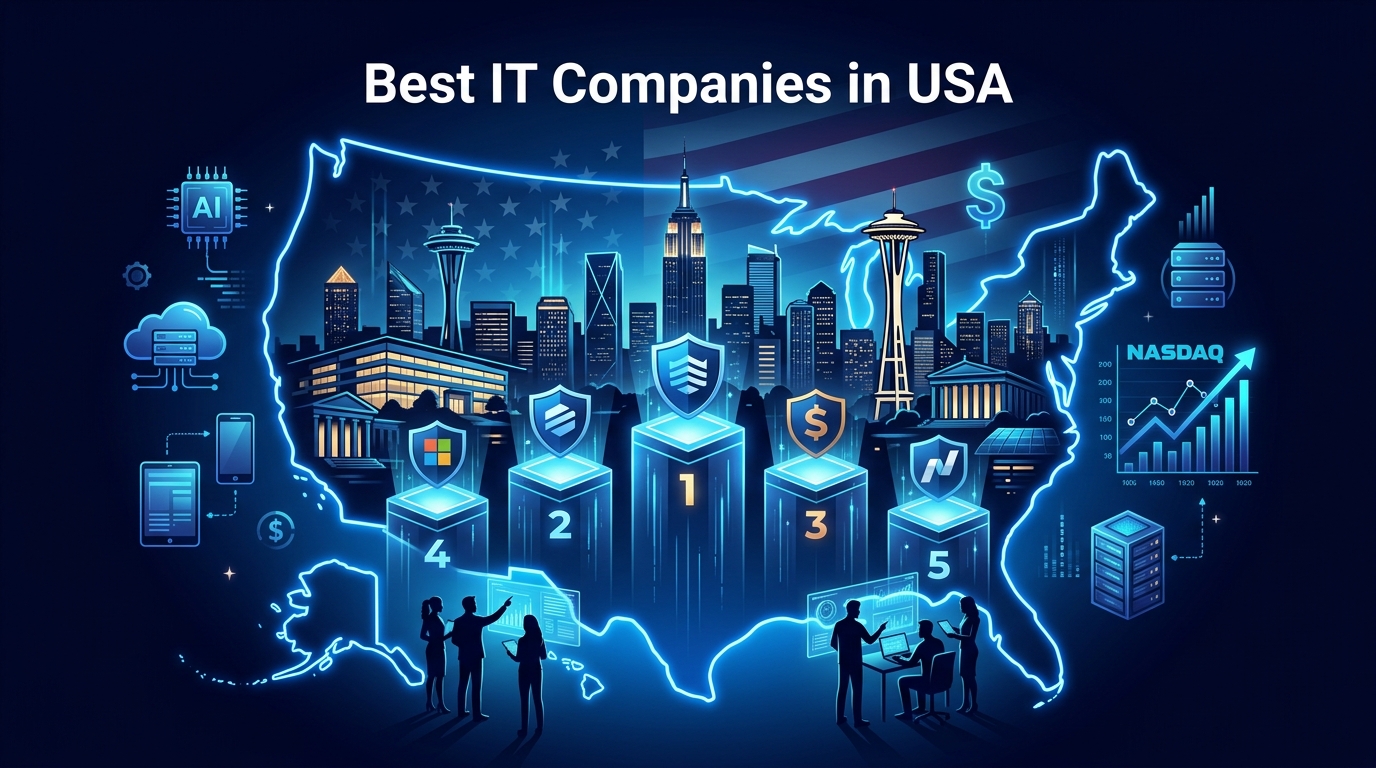
The United States technology sector is the world's largest by market capitalisation, innovation output, and talent density. American IT companies define the global standards for cloud computing, enterprise software, consumer applications, and semiconductor design. Whether you are a professional evaluating career opportunities, a business choosing technology partners, or an observer seeking to understand how the US technology landscape is structured, understanding the leading IT companies provides essential context. This guide covers the best IT companies in the USA across tiers: hyperscale platform companies, enterprise software leaders, and specialist firms that deliver exceptional outcomes for specific categories of problem.
What Defines the Best IT Companies in the USA?
Scale and market position matter but do not tell the complete story. Some of the most technically excellent and operationally excellent IT companies in the USA are not household names. The best US IT companies share common characteristics that cut across scale: genuine technical depth, product quality that earns customer loyalty rather than vendor lock-in alone, honest engineering cultures that maintain quality under commercial pressure, and the ability to attract and retain talent in the world's most competitive technology labour market.
For businesses seeking technology partners, the best IT company is the one whose specialisation, scale, process, and communication style aligns with the specific project and business context. This guide provides the context to make that determination rather than a generic ranking that ignores fit.
Hyperscale Platform Leaders
Microsoft
Microsoft has executed one of the most successful corporate reinventions in technology history. Under Satya Nadella's leadership from 2014, the company shifted its core identity from a software licensing business built on Windows and Office to a cloud-first, AI-first platform company. Azure has become the second-largest cloud infrastructure platform globally. Microsoft 365 is the standard enterprise productivity suite. GitHub, acquired in 2018, has become the central platform for global software development.
The Azure OpenAI partnership and the integration of AI Copilot capabilities across Microsoft's product suite position the company at the intersection of enterprise software and AI infrastructure, arguably the most consequential technological transition of the 2020s. For enterprise organisations evaluating technology partners, Microsoft's combination of regulatory compliance certifications, global enterprise support, and broad product surface area makes it a natural anchor vendor for large technology portfolios.
Amazon Web Services (AWS)
AWS invented the modern cloud infrastructure market and remains its dominant player, holding approximately 31 percent of global cloud infrastructure spend. The range of services is staggering: compute (EC2, Lambda), storage (S3), databases (RDS, DynamoDB, Redshift), AI/ML infrastructure (SageMaker, Bedrock), CDN (CloudFront), networking, security, IoT, and dozens of application-layer services that sit above the core infrastructure.
AWS's competitive advantage is not merely its market lead. The company invests more in its platform than competitors can match, continues to introduce services that expand the definition of what cloud infrastructure means, and maintains the deepest ecosystem of certified partners, third-party tooling, and community knowledge of any cloud provider. For engineering teams choosing a primary cloud platform, AWS's breadth, depth, and ecosystem make it the default choice unless specific services or pricing considerations tip the evaluation.
Alphabet (Google Cloud)
Google Cloud Platform occupies third position in cloud infrastructure market share but leads in specific domains: data analytics (BigQuery), machine learning infrastructure (Vertex AI, TPUs), and Kubernetes-native deployment. Google's decades of internal engineering investment in distributed systems, search infrastructure, and AI research means that the cloud products built on that foundation carry genuine technical differentiation.
For data-intensive organisations, AI-native businesses, and engineering teams with strong Kubernetes expertise, Google Cloud's product quality in its focus domains is genuinely superior to alternatives, making it the right primary choice even when its broader service catalog is shallower than AWS.
Enterprise Software Leaders
Salesforce
Salesforce built and has maintained the dominant CRM platform for over two decades. The company's ecosystem of integrated products spanning sales automation, service cloud, marketing cloud, commerce, analytics, and integration (MuleSoft) means that large enterprises can standardise their entire customer-facing technology stack on a single vendor.
Einstein GPT and the broader AI integration across Salesforce's product suite reflects the company's investment in retaining relevance as AI transforms CRM workflows. For sales and customer success leaders at enterprises, Salesforce is often not evaluated as an option but assumed as the platform. That assumption reflects genuine market dominance built on product quality and ecosystem depth over decades.
Servicenow
ServiceNow has become the default IT service management platform for large enterprises and is expanding rapidly into HR service management, security operations, and enterprise workflow automation. The platform's strength is its ability to connect disparate internal systems through configurable workflows that reduce manual process overhead in large organisations.
For IT leaders and operations executives at enterprises with 500 or more employees, ServiceNow's ITSM platform is often the highest-leverage technology investment for operational efficiency. The company's growth trajectory and expanding platform scope make it one of the more interesting enterprise software stories of the current decade.
Cloud-Native and Developer-Focused Leaders
Vercel
Vercel represents a category of best-in-class US IT company that operates at a fraction of the scale of hyperscalers but at a quality level that defines the standard for its domain. Vercel built the deployment and hosting platform that Next.js developers use as their default infrastructure, and in doing so captured the frontend developer ecosystem at exactly the moment when Next.js became the dominant React production framework.
The Vercel platform's zero-configuration deployment, global edge network, instant preview deployments for every pull request, and developer experience quality have set the standard for how web application deployment should work. Enterprise plans offering team collaboration, security controls, and SLA guarantees have moved Vercel from startup tooling to production infrastructure for companies including Airbnb, Washington Post, and thousands of high-growth SaaS businesses.
Stripe
Stripe built the payment infrastructure that powers the internet economy. Starting with a developer-first API that made accepting payments trivially simple compared to legacy alternatives, Stripe expanded into subscription billing, marketplace payments, financial accounts, fraud prevention, and tax calculation. The company processes hundreds of billions of dollars annually and has become the payment infrastructure default for startups and scale-ups globally.
Stripe's engineering culture, documentation quality, and product design standards have influenced how the entire developer tooling industry thinks about API design and developer experience. As an IT company, Stripe is significant not just for its market position but for the cultural influence it has had on how technical products are built and documented.
Specialist and Boutique IT Firms in the USA
ThoughtBot
ThoughtBot is a product development consultancy with offices in New York, Boston, Austin, and internationally. The firm specialises in Ruby on Rails development, product strategy, and UX design for startups and growth-stage companies. ThoughtBot built and open-sourced Paperclip, Shoulda, and Administrate, contributing foundational tools to the Ruby ecosystem. The consultancy model charges premium rates and delivers senior-level expertise with a genuine product mindset.
Thoughtworks
Thoughtworks operates at the intersection of technology consulting and software delivery. The firm is known for its engineering culture, the quality of its ThoughtWorks Technology Radar publication, and its expertise in enterprise agile transformation, domain-driven design, and cloud-native delivery. For large organisations undertaking complex digital transformation programs, Thoughtworks provides a consulting depth that pure IT services firms rarely match.
Basecamp / 37signals
Basecamp represents a different category entirely: a software product company that has built and maintained excellent software on a philosophy of sustainable business rather than growth-at-all-costs. Their project management and team communication products serve tens of thousands of teams. The Hey email service and their open-source Ruby on Rails framework have had outsized influence relative to the company's modest headcount. Basecamp is relevant to this list as evidence that excellent US IT companies come in many configurations.
What to Consider When Evaluating US IT Companies as Partners
For Indian businesses and professionals engaging with US IT companies as clients, employers, or partners, several considerations shape the evaluation beyond technical reputation.
Engagement model fit matters enormously. Large US IT services firms operate with delivery models, billing structures, and communication cadences designed for enterprise clients. Smaller businesses or project-specific engagements often receive less attention and less senior resources than the firm's reputation implies.
Specialisation depth should match your specific technical problem. The best US IT companies are excellent at specific things. AWS is excellent at cloud infrastructure. Stripe is excellent at payment infrastructure. Vercel is excellent at web application deployment. A company being excellent in one domain does not imply excellence in adjacent domains.
For web design and frontend engineering projects, the best IT company is one that combines UI design rigour with frontend engineering depth. UI Designer provides this combination for clients in India and internationally, building production-quality web experiences where design fidelity and technical performance are held to the same standard. If you are evaluating IT partners for a web design or development engagement, we would be glad to discuss how our approach compares to what you have seen elsewhere.